3 October 2019, By Cranes Today Magazine
For more than 50 years the concept of the telecrawler crane has intrigued the industry. Labelled, until recently, as a ‘niche’, the cranes are taking an increasing share of the market. Here, Stuart Anderson assesses the market in the smallest swing cab models, up to 30t capacity.
The first manufacturers to combine a tele boom crane with a crawler undercarriage were Grove in 1967 with their 25USt (22.7t) 225-T, followed by Coles Cranes in 1968 with the 12t capacity Hydra 120-TC. Since the Grove was also equipped with outriggers taken from its original truck crane sister machine, the Coles was the first free-on-tracks crane. Only two Grove 225Ts were sold, and while the Coles appealed to leading crane hirers such as Sparrows they proved to be the exception, and production soon ended.
Independent of these earlier efforts, in 1971 Kato Works Ltd. introduced the 16t capacity NK- 160C which would become the first successful telecrawler crane with over 250 sold. While the crane enjoyed sales in Western Europe, Russia and Oceania, the key to success was its ability to work in narrow and confined jobsites in its home market of Japan. Kato used a crawler undercarriage taken from its line of excavators which, similarly, was a fixed-gauge design with consequent limitations to over-side stability and capacity.
The first manufacturer to overcome this performance limitation was not ‘one of the big boys’ but a small, diversified engineering company based in Franklin, Tennessee named SpanDeck Engineering. Led by Bill Mitchell who had formerly worked on crawler tractors for International Harvester Company, he then built small telecrawler cranes used to assemble oil storage tanks for Pittsburgh Des Moines Steel (PDM). PDM had subcontracted the renowned former Manitowoc senior crane engineer Roche J ‘Bud’ Van de Hey of Manitowoc ‘Vicon’ fame, working at his farm in Oregon to design the crane which was named the ‘Turtle’.
PDM wanted a crane that could pass through an 8ft x 8ft (2.4m x 2.4m) door in the side of the tank which led the designer to equip the crane (for the first time) with hydraulically-extendable tracks. The 13USt capacity ‘Turtle’ subsequently gave birth to the ‘Mantis’ 3612 of 18USt (16t) capacity introduced at ConExpo 1981. Some 250 of these would be sold, with many going to utility contractors across North America as well as to the likes of the Provincial Electricity Authority (PEA) of Thailand and leading Brazilian contractor Odebrecht. Under the leadership of Bill Mitchell and his son Bill Jr. the ‘Mantis’ line steadily developed, and was acquired ten years ago by Tadano.
By the early 1980s Japanese production of mini crawler excavators exceeded 20,000 per year and within a couple of years their manufacturers were converting these into mini crawler cranes. The first to do this was Nissan Kazai Nice with their 2.9t capacity S&B-C3, introduced in 1984, followed in 1988 by IHI with their CCH-50T of 4.9t capacity that would become the first successful mini crawler crane selling worldwide.
A host of Japanese mini excavator makers—Aichi Sharyo, Hitachi, Maeda, Kobelco, Komatsu, Nagano, Nippon Sharyo, Shin Caterpillar Mitsubishi and Sumitomo—duly entered the field, generally using tele booms purchased from Tadano or Furukawa-Unic. Like mini excavators, these were 360° slew cranes with well-appointed swing cabs, tele booms typically of up to 13m length and rubber tracks of fixed gauge with nominal lifting capacities limited to 4.9t to avoid operator-licensing requirements.
During the 1990s these mini cranes established a solid market with large numbers found on urban public works projects, not only in Japan but also in similarly congested Sout East Asian markets such as Singapore, Hong Kong and Taiwan and eventually in the UK and Europe. Boom lengths continued to increase, reaching 20m extendable to approximately 24m with short fly jibs.
Although built to high-quality standards, these excavator-based cranes continued to suffer from two fundamental limitations. Due to their narrow, fixedgauge crawlers, lifting capacities over-side were weak and their pick-and-carry capacities were typically limited to 2t. While users could recognize the performance benefits of mini crawler cranes, for many years market growth outside of South East Asia and Japan was hindered by the struggle to ‘make them pay’ in hire fleets.
Along came a Spider
Starting in 1980 but gathering pace during the 1990s and 2000s, Maeda, followed by Furukawa- Unic, developed full lines of ‘Spider’ type mini crawler cranes. Featuring extremely-compact machine bodies of between 1m and 2m width these lightweight cranes achieved their lifting performance from their long outrigger arms that provided blocking dimensions of up to 6m x 6m.
Spider cranes eventually achieved capacities of up to 10t capacity but the vast majority of units sold are of 2.9-4t capacity blocked-on-outriggers. Their very light weight and small dimensions made for lower capital costs and much easier, much less-costly trucking as well as superior site access. A winning combination: with the net effect of severelyeroding market demand for the smaller-sized excavator-based swing-cab crawler cranes. Komatsu, IHI, Nagano and Hitachi, once major players, have long since exited this teleboom crawler crane sector, with only used-machines generally available.
Our study encompasses swing cab cranes of 4.9-to-30t capacity – 22 models in all. It does not include several even-smaller swing cab tele crawler cranes such as the non-slewing 2t capacity Galizia GK 20 and the full-specification Maeda CC 423S-1 of 2.93t capacity x 1.5m radius and a working weight of just 4.4t.
The cranes covered can be roughly divided into three size classes:
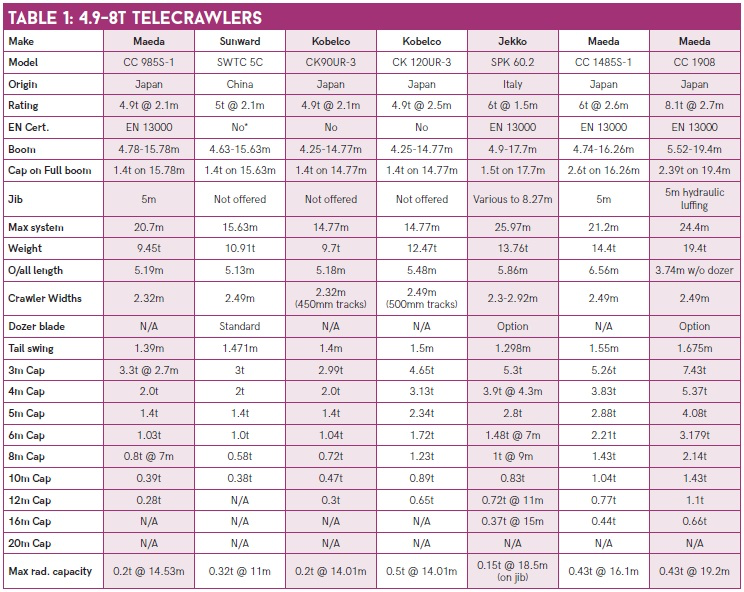
- 5-to-8t capacity: 7 models. The defining specifications of these cranes are: Long booms of 15-16m length; fully-appointed swing cabs, steel or rubber/ Geogrip tracks, very-compact dimensions including limited tail swing and transport width of 2.5m.
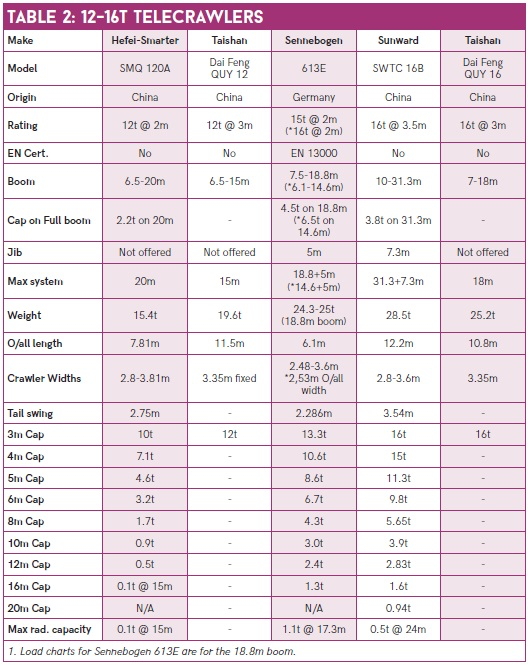
- 12-16t capacity: 5 models. Telescopic booms typically of 15-20m length with optional fly jibs (the exception being the 16t Sunward SWTC 16B with a 31.3m boom). Most models feature hydraulic track extension and working weights of 15-28t. However, in this class, only the Sennebogen 613E is designed to compact criteria.
- 20-to-30t capacity: 10 models. Telescopic booms ranging from 22 to 37m length. These are small rather than ‘mini’ tele boom crawler cranes with a greater emphasis on capacity and reach. Dimensionally, the European machines are typically moretransportable and compact than the Chinese cranes. Tadano- Mantis recently discontinued its popular 18 and 30USt (16 and 27t) models, the latter replaced by the new 35USt (32t) GTC 350.
The growth in demand for tele crawler cranes in China has been a phenomenon in recent years – sparking new as well as existing manufacturers to enter this class of crane. There is limited demand in China for ‘mini’ crawler cranes although this is developing. As with truck cranes, 25-tonners are the most popular size, followed by 50-55-tonners. As reflected in our study there are no less than ten Chinese models in these small size-classes alone with XCMG, Sany and Sunward making life very-challenging for the smaller players. As usual price competition amongst the Chinese is fierce. To date, exports beyond Asia have been minimal – limited by distribution, product support and the lack of regulatory compliance including EN 13000. However, the UK’s GGR does now offer a 5t capacity CE-certified model, named the MCC 500D and based on the Sunward SWTC 5/5C. A larger 10t capacity Sunward model is also being introduced by GGR.
Like many UK crane hirers. Dorset, UK-based Jones Crawler Cranes has transitioned much of its fleet in favour of telecrawler cranes. In addition to a 55t Marchetti, Jones recently added their first mini crawler crane in the shape of a Maeda CC 985. Managing director Mark Jones professes to “love everything about the machine” and to be “impressed with its build quality” adding that “the low emissions make this machine especially useful for us”.
Key Benefits
Key purchasing considerations vary between the smaller and larger class cranes. The emphasis in European and Japanese designs is very-much focussed on compactness, refined performance, and transportability. Manufacturing small cranes to these design parameters is very challenging and pound-for-pound more costly than larger-sized cranes to the extent that the cost of crawler cranes of 5-to-9t capacity can rival those of 25-tonners. Nevertheless their appeal continues to expand thanks to numerous unique application and performance benefits.
Clearance heights on some models are as low as under 2.5m allowing them to access low doors, tunnels, etc. that other types of mobile cranes cannot enter thus opening such markets as mining and underground road and rail infrastructure. By fitting wide triple grouser tracks or extra-wide trapezoidal swamp pads, these cranes achieve very-low ground bearing pressures for use on such projects as pipelining or electric utility-line construction and maintenance on very soft or even swampy terrain. Rubber/Geogrip track-pads allow the cranes to operate on surfaces prone to damage. The combination of rubber tracks, low centre of gravity and compact dimensions also make these cranes ideal for working on elevated bridges and similarly potentially-hazardous elevated job sites.
The option of radio remote control available on many models allows these cranes to operate in potentially-dangerous environments or where operator visibility of the jobsite might be hindered.
Most models are available with hoists allowing considerable rope spooling capacity for hoisting and lowering to depths as great as 100m below grade.
Fully mobile lifting performance allows these cranes to position and install such items as road/noise barriers, panel work, tunnel liners, etc. By installing earth-augers and elevated work platforms they can erect power transmission lines on un-prepared ground.
Small machines with tracks retracted can achieve clearance widths as small as 2.5m and not only travel but ‘lift’ at such operating widths. Many machines combine zero or limited tail swing with long booms capable of working at steep angles, allowing them to reach heights up to 20- 35m in site spaces too-narrow for most mobile cranes. This allows them to work in busy urban areas – for example installing plate glass using suction pads – with minimal disruption to traffic-flow.
Compared to the exposed operator’s seat of ‘Spider’ cranes, the sealed, heated and air-conditioned operator’s cabs of small crawler cranes afford operator with a safer working environment protected from the weather and site hazards as well as dust, sand, etc. The cabs also afford protection and security to the electronics, controls, instruments and personal effects of the operator. Some models are offered with cabs fitted with steel windscreen grids and/or roof guards for FOPs protection.
Barge work is an ideal application for telecrawlers: the swing cab is essential for field-of vision and safety and the crawler undercarriage provides a stable base that can be easily tied-down as needed.
Several smaller-sized models are available with dozer blades that add a level of extra stability and can be used for backfilling trenches and other jobs. Many medium-tolarger sized models are available with optional man baskets and forklift attachments or even ropesuspended hydraulic grabs.
Customers are constantly discovering new applications for these cranes that might otherwise have been thought to demand larger mobile or small tower cranes. In an ever more-crowded world with ever-increasing demands on space, fuel-economy and environmental friendliness, smaller-sized machines are increasingly favoured.
The Latest Models
At Bauma. mini crawler crane market-leader Maeda introduced its largest model to date – the 8.1t capacity CC 1908 S-1, its fourth swing cab crane joining a strong line of spider cranes. The CC 1908S-1 is rated 8.1t at 2.7m radius and is equipped with a fivesection hexagonal boom offering 20.1m maximum lift height which can be increased to 26.0m with the optional fly jib. Maximum working radius is 19.2m and maximum pick-and-carry capacity is 3.5t.
New features of the CC 1908 include a ten-inch (254mm) touchscreen monitor display, surround view camera and boom slew limit setting. The operator’s cab is fully-enclosed and airconditioned with sliding door and new wide-view roof window with sun shade. It has a two-speed winch allowing either two, four or six-part reeving, hydrostatic transmission, a tilt sensor/alarm as well as an anti-slack device.
Commenting on the new crane, Anthony Heeks, managing director of Pace Cranes, based in Sydney, said: “It’s ideal for working in confined areas and construction sites for working up-and-over objects with the hydraulic luffing and telescoping fly jib. Its 3.5t Pick-and-carry capacities are a major improvement while its minimal tail swing make it ideal for indoor work as well. We expect to see the model in full production in the 3rd quarter of this year with units landing in Australia shortly thereafter.” Pace has been the Maeda distributor for Oceania since 1992 and has delivered over 800 Maeda crawlers. The addition of the Sennebogen franchise allowed the company to offer their customers a full line of tele boom crawler cranes of size classes up to 130t but while the 40, 50 and 70-tonners remain their best sellers, the smaller models now capture some 25% of demand.
Originally introduced in 2016 but now in a second-generation, the 6t capacity Jekko SPK 60-2 is a machine with very-high specification criteria. This second generation model features new software with a self-diagnostic system and automatically selects the working slope. Despite being in a highly price-competitive market, Jekko has spared nothing in the way of specification features. Topping its 17.7m five-section boom is a choice of four jibs including a 7.5m telescopic luffing fly jib. It’s the only swing cab mini crawler crane available with the option of electric instead of diesel power. Radio remote control, extendable tracks, FOPS cab and rubber/Geogrip extending crawlers are also available.
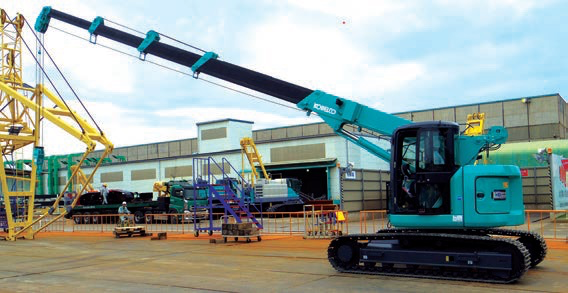
The Kobelco CK 90UR-3 is the third generation of this proven design. The latest version features a unique iNDr (Integrated Noise & Dust Reduction) cooling system with which airflow to the Isuzu engine from inlet to outlet is kept to a single duct within which the engine and cooling system are sited. To facilitate long work shifts at night or in tunnels, the Kobelco is equipped as standard with work lights and powered by a large 50A alternator.
Another unusual and valuable feature is that the main winch is mounted at the front of the crane superstructure deck which allows the crane operator to visually check rope spooling, etc, from his cab seat. Also, to reduce servicing demands the CK 90UR-3 uses longlife hydraulic oil that only needs changing at 5,000hr intervals.
Justin Potter, sales manager for Australian Crane & Machinery told Cranes Today that Adelaidebased McMahon Services Australia had acquired a CK 90UR-3 as well as a 250t Kobelco CK 2500G- 2. “The market is pretty solid at present and we have had good success with Kobelco telecrawler cranes in both Australia and New Zealand. McMahon are using the CK 90UR-3 on slab work using the fully extended five section boom at maximum elevation”.
One of the most wellestablished cranes on the market is Sennebogen’s 613. Originally introduced in 1992, at Bauma Sennebogen introduced its ‘E’ generation, the only machine in the class available in both crawler and wheel-mounted versions. While the wheel-mount remains very popular in Central Europe, the 613 crawler has found a ready market in Oceania where crane hire companies such as Preston Crane Hire and WGC have acquired significant fleets of Sennebogen crawlers. In addition to fifteen swing cab Maedas, Preston has the largest fleet of Sennebogen tele crawlers operating in Oceania including six 613s with units currently working in Australia, New Zealand and Papua New Guinea.
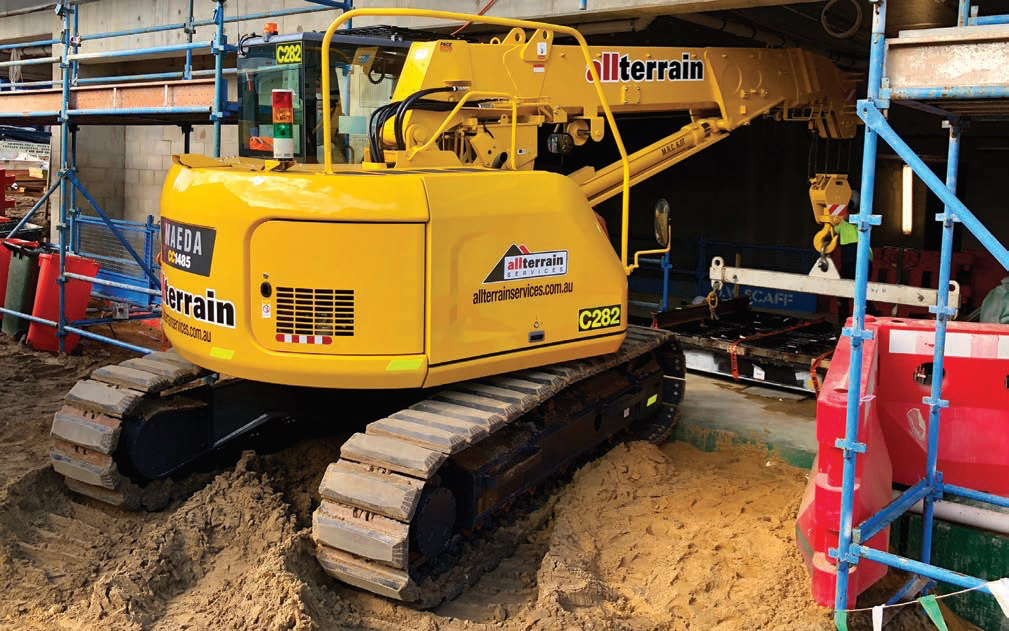
The first ‘E’ Generation 613 models sold in Australia have been acquired by All Terrain Services in Perth, WA and Coopers Heavy Industries in NSW. All Terrain Services specializes in Manitou and Magni telehandlers and has operated Maeda minis for around ten years. The Sennebogen is part of a strategy to extend their telecrawler fleet into larger classes.
Demand for these machines is coming from a whole range of applications including infrastructure construction as well as maritime construction, mining, demolition and civil construction. According to general manager Todd Jackson, “This demand is due to a greater focus on safety and efficiency in the workplace… as well as projects becoming more congested and technically more difficult in their construction.” Jackson purchased the 613E complete with the optional rubber pads, 5m fly jib and 1.75m elevating MultiCab and it joins a crane fleet that includes 20 and 25t Frannas, a 110t Tadano, 140t Demag AC 140 and a new 220t AC 220-5 Demag.
Even in the deeply-depressed UK crawler crane market, Sennebogen’s well-established distributor AGD Equipment succeeded in placing two 613Es on the £7bn ThamesLink London rail network project where duties include back-up on man-riding duties on deep shafts. AGD’s managing director Robert Law told Cranes Today that the compact dimensions and quality of the 613E as well as its elevating operator’s cab were key criteria in intense negotiations with the contractor.
While the UK market may be down, Sennebogen is enjoying particularly strong sales of tele and lattice crawlers across the Channel. Sygmat, the Sennebogen distributor recently delivered the first 30t 633E to ATM-Levage based in Valento, SE Paris who are making something of a specialty of tele crawlers. It joins a fleet that includes 16t Sennebogen 613Es (R & M), 70t 673E and 120t 6113E as well as Maeda LC 383, LC 785, CC 985 and CC 1485. At Bauma ATM ordered the first CC 1908 in France – their 16th Maeda in 2 years. Meanwhile Mategrues based in Beauchamp NW of Paris specializes in the bare (or dry) rent of tele crawler cranes having recently added a 16t 613E to a fleet that includes Sennebogen 630R, 643R and 653R of 30, 40 and 50t capacity.
Maeda has also expanded its French dealer network, appointing Klaas All Road for the Picardie and Champagne-Ardennes region who ordered four spider cranes as well as CC 423 and CC 985 swing cab models.
In recent years Marchetti has placed considerable emphasis on the development of its line of telecrawlers, which now numbers five models to 70t capacity. The smallest of these is the 25t CW 25/35 ‘Sherpina’, the best-selling model in its size class in the European market. Key to the popularity of the Sherpina are its 25m five-section ‘droop-snoot’ boom, very short transport length, low weight, 2.5m transport width and reliability. To date there are over 20 Sherpinas working in the UK alone.
“It’s absolutely bullet-proof” says AGD’s Law. “Marchetti build a simple, strong crane and ultimately that’s what most customers want. The Sherpina is also extremely compact, easy to transport and small enough to access very confined sites”. Farnborough, Hants-based TCA Lifting is the latest UK crane hire company to add the Sherpina to its tele crawler crane fleet.Designed to somewhat different parameters is the T35 produced by Osima, Ancona, Italy-based MAIT. Well known for their line of foundation machines and lattice cranes, the T 35 is MAIT’s first tele crawler and is aimed at their traditional markets. The 30t capacity crane is a true heavy-duty machine of 39.5t working weight and powered by a 129kW Cummins driving a 93kN main hoist with 20mm wire rope and 40kN aux hoist with 16mm rope. MAIT point to contractor’s ability to transport this crane as a complete single load as its key advantage over lattice foundation cranes.